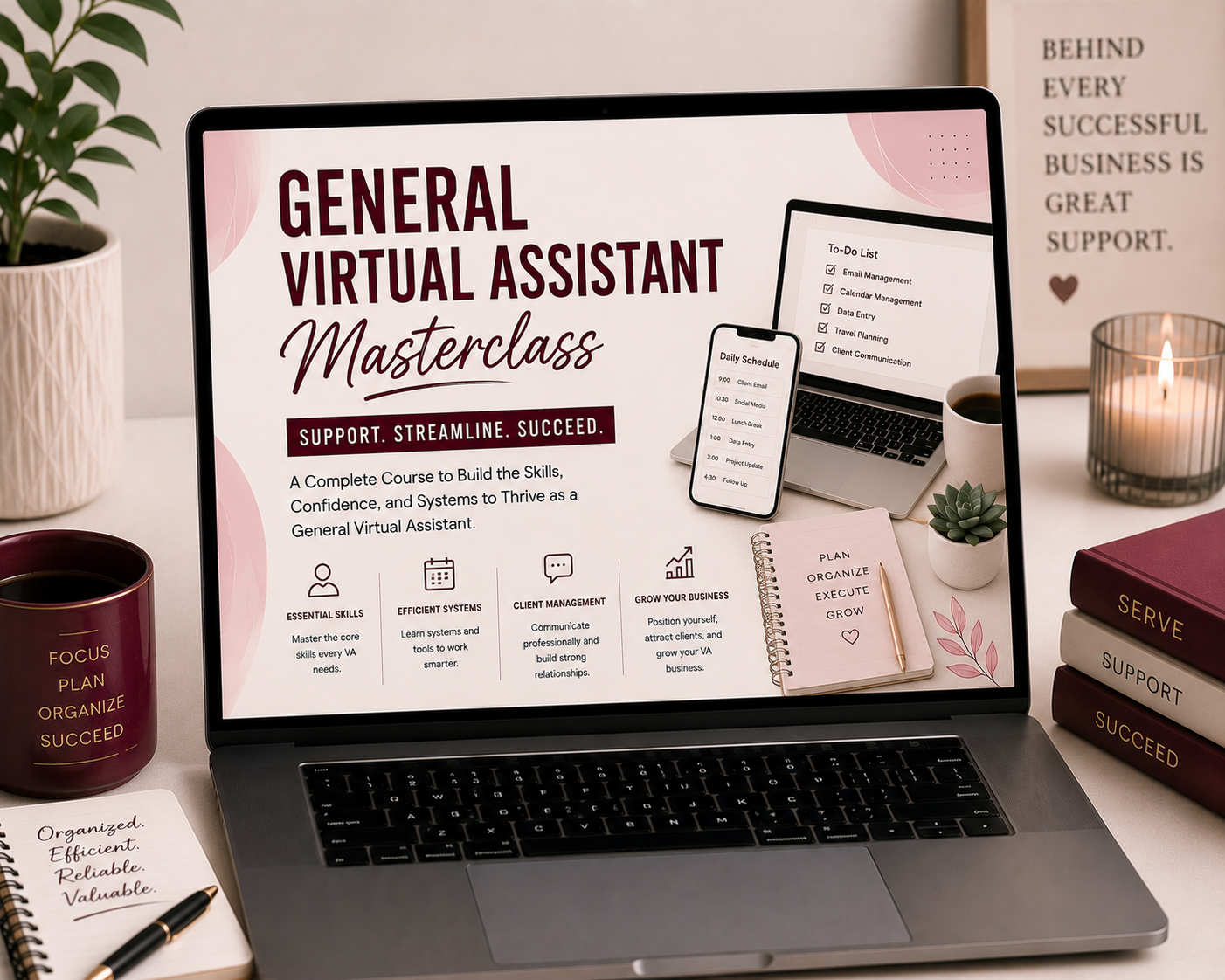
General Virtual Assistant Masterclass – Advanced

Uncategorized
Wishlist Share

About Course

Launch your freelance career with confidence through this practical, beginner-friendly Virtual Assistant course. Designed for aspiring freelancers, this program covers everything you need to get started — from essential VA skills like email and calendar management to client communication, productivity tools, and finding your first clients. You’ll also learn how to package your services, set your rates, and build a sustainable remote career. Perfect for anyone ready to work from home and earn online with in-demand digital skills.

What Will You Learn?

  • Virtual Assistance Fundamentals
  • Freelancing Fundamentals & Professional Mindset
  • Communication Skills
  • Google Workspace & Essential VA Tools
  • Administrative Support
  • Calendar & Email Management
  • Project Management & Collaboration
  • Data Entry & Data Management
  • Lead Generation & Lead Qualification
  • Social Media Management
  • Content Creation, Planning & Scheduling
  • Canva & Graphic Design
  • Branding & Marketing Materials
  • Website & WordPress Content Management
  • Freelance Profile Optimization
  • Building a Professional Portfolio
  • Finding VA Clients
  • Writing Winning Proposals
  • Preparing for Client Interviews
  • Client Onboarding
  • Pricing Your VA Services
  • Client Retention & Long-Term Relationships
  • Career Growth & Service Diversification
  • Building Your Own VA Agency

Course Content

Introduction to General Virtual Assistance
Start your journey into freelancing by understanding what virtual assistance is and why it’s a high-demand career today. This module sets the foundation, gives you a clear direction, and prepares you for the skills and opportunities ahead.

  • What is a Virtual Assistant?
    04:06
  • What are VA Niches?
    03:32
  • What is Freelancing?
    02:31
  • Skills Needed to Become a VA
    02:08
  • Helpful Resources
  • Quiz #1

Mastering the Tools Used by Virtual Assistants
Virtual Assistants rely on a variety of digital tools to communicate with clients, organize tasks, collaborate with teams, and improve productivity. Knowing how to use these tools efficiently is one of the most valuable skills a VA can develop. In this module, learners will explore the most commonly used applications in the virtual assistance industry and understand how each tool contributes to a productive remote work environment.

Communication Skills
Strong communication is one of the most valuable skills a Virtual Assistant can possess. Whether responding to emails, assisting customers through live chat, attending meetings, or communicating with clients, a VA represents the business professionally. Clear, concise, and respectful communication builds trust, minimizes misunderstandings, and contributes to long-term client relationships. In this module, learners will develop the communication skills required to interact confidently with clients and teams in a remote work environment. They will also learn how to write professional emails, apply proper chat etiquette, improve their business English, and create accurate meeting minutes.

Administrative Support Skills
Scheduling appointments and managing emails are two of the most common responsibilities of a Virtual Assistant. Clients depend on VAs to organize their schedules, prevent conflicts, and ensure important messages are prioritized and responded to promptly. Proper calendar and email management improve productivity, reduce missed deadlines, and create a professional experience for clients and customers.

Lead Generation
Lead generation is one of the most in-demand services offered by Virtual Assistants. Businesses rely on qualified leads to grow their customer base, increase sales, and expand their network. A Lead Generation Virtual Assistant helps identify potential customers, collect accurate contact information, and organize prospect data for marketing and sales teams. In this module, learners will understand the lead generation process, learn how to find and qualify prospects, and organize lead information using spreadsheets and Customer Relationship Management (CRM) systems. They will also explore best practices for maintaining accurate records and supporting outreach campaigns.

Social Media Management
Social media has become one of the most powerful tools for businesses to build brand awareness, engage with customers, and generate sales. Many business owners hire Virtual Assistants to manage their social media presence, create content, schedule posts, respond to messages, and analyze performance. In this module, learners will gain the foundational knowledge and practical skills needed to manage business social media accounts professionally. They will learn how to create engaging content, use scheduling tools, interact with online communities, and evaluate social media performance using analytics.

Graphic Design for VAs
Graphic design is a valuable skill for Virtual Assistants, especially those supporting clients in marketing, social media, e-commerce, and content creation. While VAs are not expected to become professional graphic designers, they should be able to create visually appealing and brand-consistent designs for everyday business needs. In this module, learners will explore the basic principles of graphic design, become familiar with Canva, and create professional marketing materials for social media, presentations, and business promotions.

Website Content Management
A website is one of the most important digital assets of any business. It serves as an online storefront, marketing platform, and source of information for customers. Many businesses hire Virtual Assistants to maintain their websites by updating content, publishing blog posts, uploading images, and ensuring information remains accurate and up to date. In this module, learners will gain practical knowledge of website content management using WordPress, one of the world's most popular Content Management Systems (CMS). They will learn how to navigate the WordPress dashboard, create and update website content, manage media files, and apply basic Search Engine Optimization (SEO) techniques.

Marketing Your VA Services & Getting Clients
Becoming a skilled Virtual Assistant is only the first step toward building a successful freelancing career. To secure clients, VAs must know how to market their services, establish a professional online presence, and communicate their value effectively. Successful freelancers understand how to position themselves, create compelling profiles and portfolios, and actively seek opportunities through networking and client outreach. In this module, learners will discover practical strategies for promoting their Virtual Assistant services, creating a strong personal brand, building a portfolio, and finding clients through freelance platforms, social media, and direct outreach. They will also learn best practices for writing proposals, preparing for client interviews, and nurturing long-term client relationships.

Freelancing & Portfolio Building
Launching a successful Virtual Assistant career requires more than technical skills. Freelancers must understand how to manage their business, establish professional workflows, price their services, and present their work effectively. A strong portfolio demonstrates competence, while good freelancing practices help build credibility, attract clients, and sustain long-term success. In this final module, learners will explore the fundamentals of freelancing, develop a professional portfolio, learn how to manage client projects, and prepare for their transition into the Virtual Assistant industry.

Student Ratings & Reviews

No Review Yet
No Review Yet

More than just a freelancer, I work as a dedicated partner focused on your long-term growth, bringing strategy, execution, and consistent support to help your business move forward.

© 2026 Maia Estrera. All rights reserved.